August 21, 2026
Ten transformations. Four industries. Scales from $40M to $3.2B
By Dr. Koby Glass
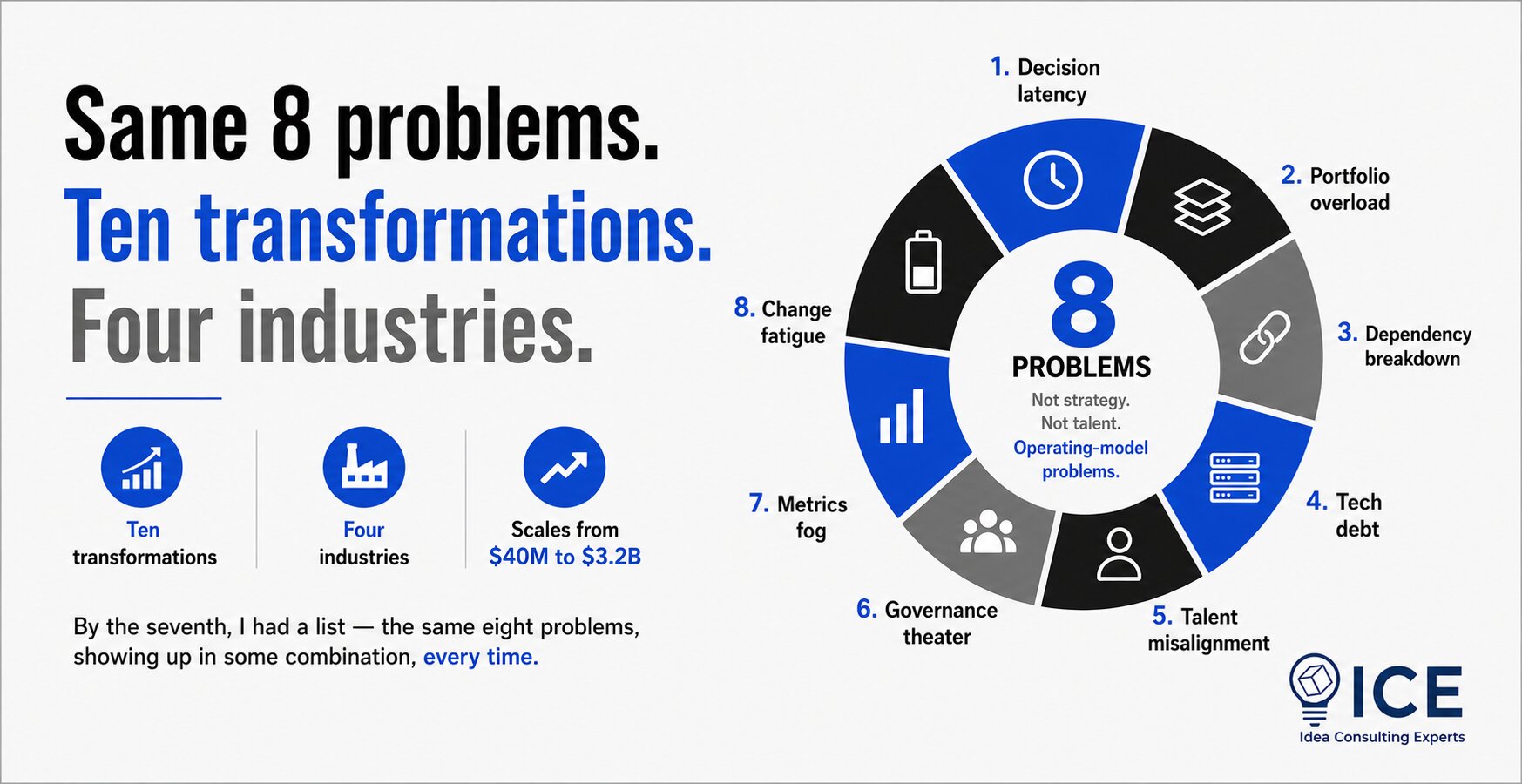
By the fourth one, I stopped believing that failed transformations fail for unique reasons. By the seventh, I had a list - the same eight problems, showing up in some combination, every time. Every program I've ever inherited that was Red had at least four of these running simultaneously:
1: Decision latency: Strategic calls that should take 72 hours taking 18 days, because no one wrote down who decides what.
2: Portfolio overload: Teams running at 107%+ utilization, absorbing "one more initiative" that slows down everything already in flight.
3:Dependency breakdown: One delayed sign-off quietly killing four downstream projects, because dependencies were never mapped.
4:Tech debt: Environments unstable enough that the platform itself becomes the blocker, not the strategy running on it.
5:Talent misalignment: Open decisions with no named owner - accountability that exists on an org chart but not on a decision log.
6: Governance theater: Meeting hours that produce status updates instead of decisions.
7: Metrics fog: Two workstreams fighting over the same KPI because nobody wrote the data dictionary.
8: Change fatigue: A workforce that has learned, correctly, that transformations are something to survive rather than something to build.
None of these are strategy problems. None of them are talent problems, in the sense of people being unqualified.
They're operating-model problems - the layer above the framework that governs how decisions get made, how capacity gets allocated, and how accountability actually lives day to day.
The diagnostic question worth asking this week: how many of the eight can you name, right now, in your own program?
Most executives can name two or three from memory. The programs that are actually in trouble have four or more running Red at once, and usually don't know it until someone measures it.