August 17, 2026
Little's Law: the equation nobody explained to you before your transformation stalled
By Dr. Koby Glass
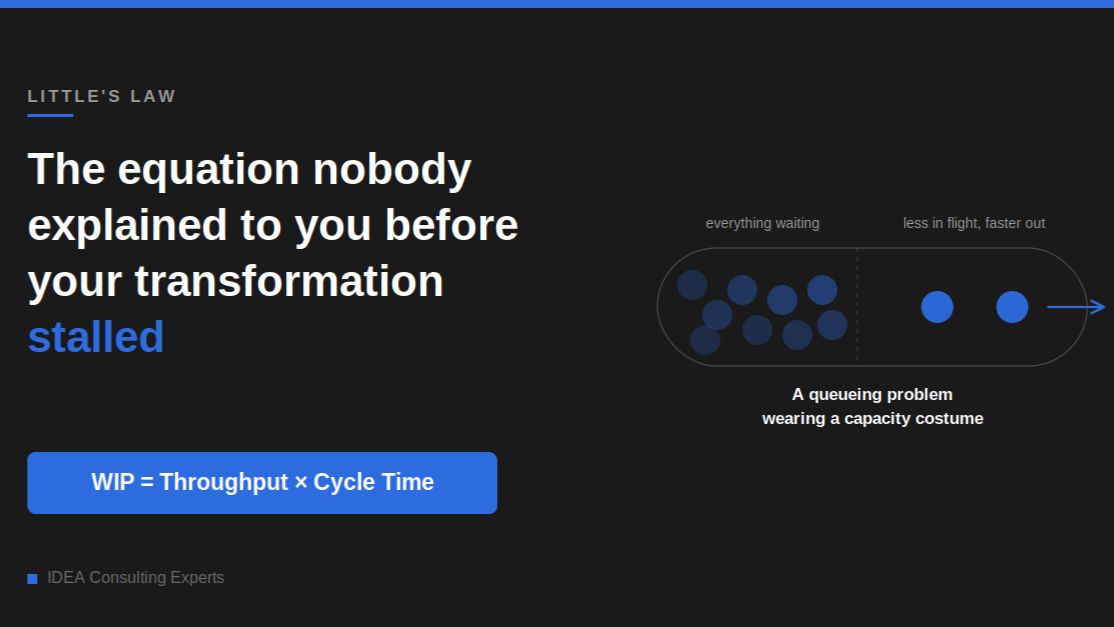
Every executive I've worked with has heard "we need more throughput." Almost none of them have heard of the equation that governs it.
Little's Law is simple: the time something spends in your system equals the number of things in the system, divided by the rate at which you finish them. Move that around, and it tells you exactly why your delivery crisis exists — and exactly what will and won't fix it.
On a recent Payments engagement, we tracked a value stream from Week 22 to Week 27. The team wasn't understaffed. They weren't underskilled. They had too much work-in-progress relative to their finishing rate — the classic Little's Law violation. More work in flight doesn't mean more gets delivered. It means everything takes longer to finish, including the things that were already almost done.
The intervention wasn't "work harder" or "hire more people." It was reducing WIP — cutting the number of things in flight until the math balanced again. Throughput on that stream increased 25%, and rework dropped 35%, worth roughly $4.9M annualized against a $14M rework baseline. Nobody added headcount. We just stopped starting so much and started finishing what was already open.
Most "delivery crises" aren't capacity problems. They're queueing problems wearing a capacity costume.
Before your next resourcing conversation, ask a simpler question first: how much work is currently in flight, and how much of it is actually moving?
If you can name three or more of the 8 problems running in your own transformation right now, the operating model above your framework is broken.